
Precision Vibration Isolators & Industrial Mounts
Explore our factory-engineered anti-vibration solutions designed for heavy electrical transformers, HVAC infrastructure, and high-load mechanical plants.



Transformer Vibration Dynamics: Magnetostriction & Harmonic Control
An in-depth technical examination of electromagnetic force excitation, core noise propagation, and mechanical wave isolation in medium and high-voltage power equipment.
Root Mechanics: Magnetostriction & Lorentz Forces
Electrical transformers generate structural vibration primarily through two physics phenomena: core magnetostriction and winding Lorentz forces. Magnetostriction causes silicon steel laminations to expand and contract twice per AC cycle, creating a fundamental excitation frequency of 100 Hz (in 50 Hz grids) or 120 Hz (in 60 Hz grids). Additionally, higher harmonic frequencies (200 Hz, 300 Hz, 360 Hz) emanate from non-linear core magnetic flux densities and load-current interactions. Without isolation, these micro-scale mechanical oscillations transfer directly into building foundations, radiating airborne low-frequency hum throughout commercial and industrial facilities.
Isolation Mathematics & Transmissibility
Achieving superior vibration attenuation requires tuning the mechanical isolation system's natural frequency ($f_n$) relative to the transformer's forcing frequency ($f_d$). Isolation only occurs when $f_d / f_n > \sqrt{2} \approx 1.41$. To achieve >95% attenuation, the frequency ratio must exceed 3.0.
Market Drivers for Low-Cost, High-Performance Isolators
How global urban expansion, strict environmental noise regulations, and hyperscale data center construction drive modern procurement decisions.
Hyperscale Data Centers & AI Nodes
Modern AI workloads require high-density power distribution, placing mega-watt dry-type step-down transformers in close proximity to sensitive IT racks and cooling units. Unisolated structural vibration threatens solder joints, optical interconnects, and sensitive server components. Engineers mandate zero-resonance spring and elastomeric isolators that comply with strict dBA thresholds in computer rooms.
Urban Commercial Substation Retrofits
As metropolitan electrical grids expand, medium-voltage substations are increasingly sited within mixed-use commercial towers, underground parking structures, and residential districts. Regulatory bodies (such as IEEE 656 and NEMA TR-1) enforce tight structural vibration and acoustic emission limits (under 35 dBA at property lines), mandating high-efficiency isolation mounts.
Renewable Grid Integration & Microgrids
Utility-scale solar farms, wind turbine substations, and Battery Energy Storage Systems (BESS) experience variable current loading, generating wideband electrical harmonics. Variable excitation frequencies degrade standard mounting pads, necessitating heavy-duty damped spring mounts capable of wide-frequency harmonic absorption.
Bellking Industrial Performance Metrics
Empirical proof of quality, testing rigor, and global supply capacity from our Kunshan Industry 4.0 plant.
China Industry 4.0: Supply Chain Resilience & Cost Optimization
Why sourcing directly from Bellking's Kunshan manufacturing base delivers premium structural performance at competitive pricing without compromising quality or durability.
Automated Coiling & Vulcanization
Computer-controlled CNC cold-coiling machines and robotic liquid injection molding ensure uniform spring rate ($k$) and consistent elastomeric density across all production runs.
High-Grade Metallurgy & Dacromet Finish
Utilizing 60Si2Mn high-fatigue spring steel paired with multi-layer Dacromet surface treatment, offering up to 900 hours of neutral salt spray corrosion resistance for harsh coastal and industrial environments.
Lean Cost Engineering & Fast Turnaround
Integrated material sourcing in Yangtze River Delta cluster cuts raw material overhead by up to 35%, passing direct savings to procurement engineering teams worldwide.
| Isolator Series | Core Material | Natural Freq (Hz) | Load Capacity | Primary Application |
|---|---|---|---|---|
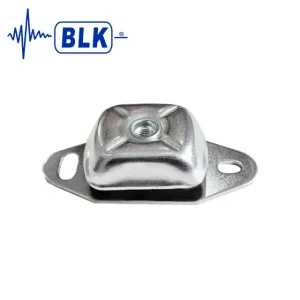
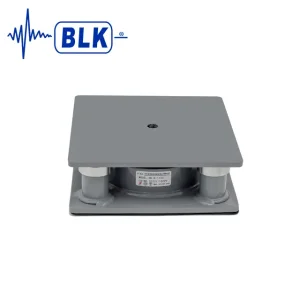
| BK-DS Damped Spring | 60Si2Mn Alloy Steel | 3.0 - 5.0 Hz | 50 - 3,500 kg | Oil & Dry Transformers |
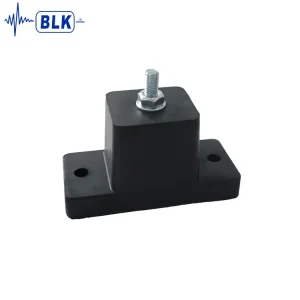
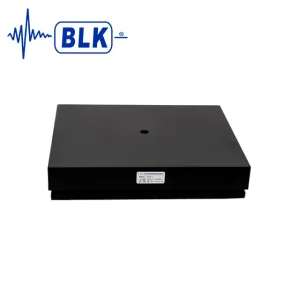
| BKTS Rubber Pad | High-Density EPDM / NBR | 8.0 - 12.0 Hz | 100 - 10,000 kg | Substation Base Plates |
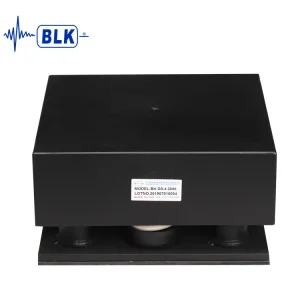
| BK-R Air Mount | Pneumatic Elastomer | 1.7 - 2.5 Hz | 200 - 5,000 kg | Precision Metrology & Cleanrooms |
| BKM Rubber Mount | Neoprene Compound | 6.0 - 9.0 Hz | 30 - 800 kg | HVAC & Aux Electrical Boxes |
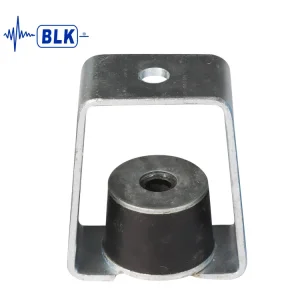
| HR Hanger Type | Steel Spring + Rubber Pad | 3.5 - 6.0 Hz | 20 - 1,200 kg | Suspended Busbars & Piping |
Localized Application Scenarios & Engineering Practices
Tailored mounting strategies designed to address unique structural, climate, and acoustic challenges across industries.
1. High-Rise Commercial Towers
Challenge: Dry-type transformers installed on upper-floor electrical rooms transmit solid-borne hum through concrete slabs into tenant offices.
Solution: Install dual-stage BK-DS damped spring isolators with BKTS elastomeric leveling pads beneath transformer skids, achieving 98% isolation at 100 Hz.
2. Outdoor Coastal Substations
Challenge: Salt mist corrosion degrades standard metallic springs while severe ocean winds introduce lateral shear loads.
Solution: Deploy 900-hour salt-spray tested Dacromet-coated spring mounts featuring integrated seismic limiters and wind shear restraints.
3. Semiconductor Cleanrooms
Challenge: Step-down transformers adjacent to optical lithography units introduce low-amplitude structural micro-vibrations.
Solution: Active-ready BK-R pneumatic isolators with sub-2.0 Hz natural frequency eliminate sub-harmonic interference with process tools.
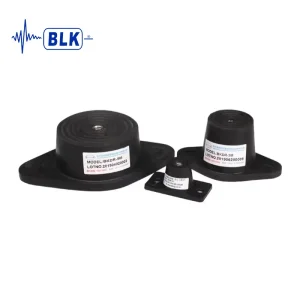
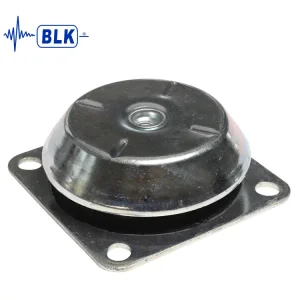
Specialized Isolation Platforms & Heavy Rubber Mounts
Explore additional high-performance products within our extensive anti-vibration portfolio.



Frequently Asked Engineering Questions
Clear, authoritative answers to critical procurement and sizing queries, backed by over 13 years of field expertise.
Request a Custom Engineering Calculation & Quote
Send us your equipment specifications today. Our engineering team will analyze your system requirements and deliver a customized vibration isolation plan within 24 hours.