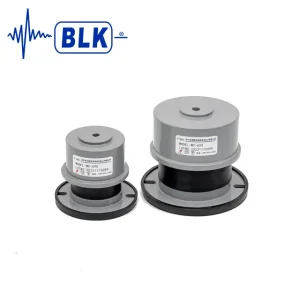
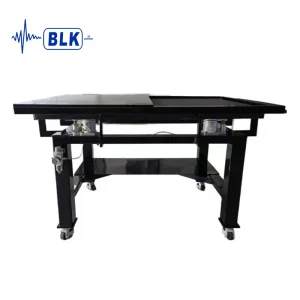
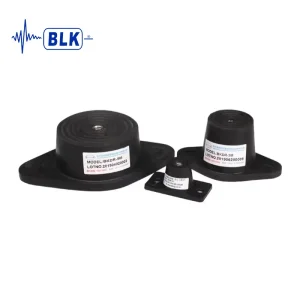
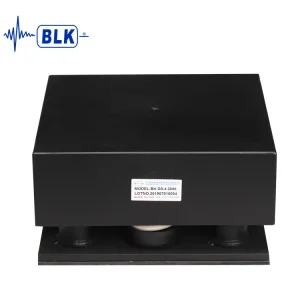
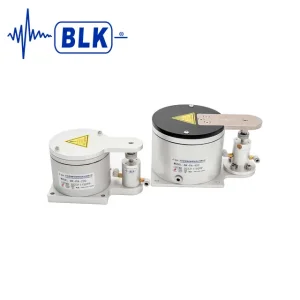
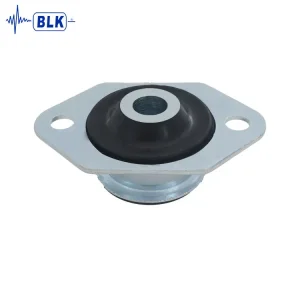
High-Performance Isolators & Shock Absorption Mounts
Engineered for low dynamic transmissibility, structural durability, and high environmental resistance. Select from standard configurations or request 1:1 OEM customization.
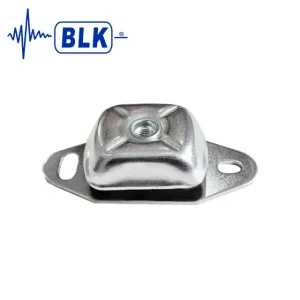




Global Industry Trends in Vibration Isolation Technology (2026-2035)
In modern industrial engineering, controlling structure-borne noise and dynamic vibration is no longer merely a maintenance secondary thought—it is a mandatory metric for precision operational compliance, structural health, and environmental safety. As global manufacturing transitions toward sub-nanometer semiconductor fabrication, high-speed rail networks, ultra-quiet HVAC installations in smart buildings, and gigawatt-scale power infrastructure, the global demand for advanced Vibration Absorbing Material Factories & Manufacturers has escalated exponentially.
1. Shift Toward Micro-Vibration Isolation & Sub-Hz Tuning
Traditional vibration damping focused primarily on macro-amplitude isolation (such as heavy diesel generators or industrial stamping presses operating above 15 Hz). However, the semiconductor, optical metrology, and bio-nanotechnology industries demand active and passive systems capable of damping micro-vibrations with amplitudes measured in nanometers. This has driven advanced manufacturers to move beyond simple elastomeric blocks toward multi-layer viscoelastic polymers and pneumatic air isolation systems operating at ultra-low natural frequencies ($f_n \le 1.7 \text{ Hz}$).
2. ESG, Decibel Compliance, and Urban Acoustic Standards
Global municipal codes and workplace safety frameworks (such as ISO 3744, OSHA sound exposure limits, and LEED v4.1 acoustic standards) are enforcing stricter noise pollution thresholds. Rooftop HVAC units, cooling towers, and industrial pump installations in mixed-use urban zones require dynamic structural isolation exceeding 95% transmissibility reduction. Low-quality dampeners degrade prematurely, resulting in structural noise leakage and non-compliance fines for building developers.
3. Polymer Material Science Breakthroughs
The industrial market is phasing out unblended natural rubber formulations in favor of synthetic co-polymers, high-damping polyurethane elastomer blends, and cross-linked visco-elastic matrices. These materials display superior loss factors ($\eta > 0.3$), high resistance to atmospheric ozone, UV degradation, oil saturation, and thermal fatigue, enabling operational lifespans exceeding 15 years even in hostile chemical processing environments.
What Global Enterprises Demand from Vibration Material Manufacturers
B2B procurement officers, EPC contractors, and structural engineering consultants require verified physical metrics rather than marketing claims. Sourcing low-price vibration damping materials demands strict verification of physical dynamics.
Verified Loss Factor & Stiffness Ratio
Procurement teams demand certified dynamic-to-static stiffness ratios ($K_d / K_s \le 1.4$) and high loss factors to ensure predictable deflection under varying static load conditions without risk of resonance shift.
Long-Term Creep Resistance
Static load creep leads to equipment misalignment and pipe strain over time. Premium factories guarantee compression set metrics below 15% under long-term continuous static stress (ASTM D395 Method B testing).
Corrosion & Extreme Weather Durability
For outdoor HVAC platforms, offshore oil rigs, and electrical substations, housing hardware must feature Dacromet coating or hot-dip galvanizing passing at least 900 hours of continuous salt-spray testing (ASTM B117).
Technical Comparison Matrix: Vibration Isolator Material Families
To assist procurement managers in selecting cost-optimized damping materials, the table below provides a engineering benchmark of primary material types produced by specialized Chinese manufacturing hubs:
| Material / Mount Class | Natural Frequency ($f_n$) | Damping Ratio ($\zeta$) | Max Load Range (per mount) | Primary Application Environment | TCO & Price Index |
|---|---|---|---|---|---|
| High-Damping Polymer Pads (BK-PM) | 8.0 - 14.0 Hz | 0.12 - 0.22 | 50 kg - 50,000 kg | Foundations, structural acoustic breaks, heavy equipment beds | Low / Highest ROI |
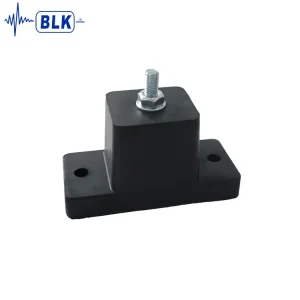
| Neoprene / Nitrile Rubber Mounts (BKM/BKVV) | 5.0 - 10.0 Hz | 0.05 - 0.10 | 10 kg - 2,500 kg | Compressors, small pumps, HVAC fans, automotive assemblies | Economical |
| Viscous Damped Spring Mounts (MD/MC) | 3.0 - 5.0 Hz | 0.08 - 0.18 | 100 kg - 8,000 kg | Chillers, cooling towers, heavy engine-generator sets | Mid-Range |
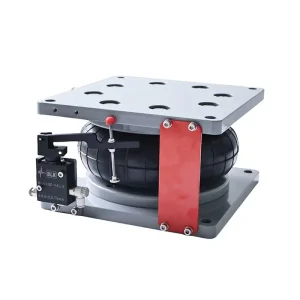
| Precision Pneumatic Air Mounts (BK-PF/PA) | 1.7 - 2.5 Hz | 0.15 - 0.25 | 50 kg - 3,500 kg | Semiconductor inspection, optical tables, CMM machinery | Premium / High Tech |
China Industry 4.0: Supply Chain Resilience & Cost-Efficiency
Western engineering teams often ask how Chinese Low Price Vibration Absorbing Material Factories maintain ultra-competitive wholesale pricing while exceeding rigorous Western performance standards. The competitive edge of top-tier manufacturing hubs (such as Kunshan, Jiangsu) rests upon three core pillars: integrated vertical supply chains, advanced automated vulcanization, and continuous material science innovation.
1. Full Vertical Integration from Polymer Synthesis to Metalwork
Leading Chinese manufacturers do not outsource key sub-components. In facilities located in industrial manufacturing clusters like Kunshan, raw rubber compounding, synthetic polymer formulation, steel spring coiling, robotic welding, and automated surface treatment occur within a single industrial campus. This eliminates double-tier markups and reduces component lead times from weeks to days.
2. Automation, Robotic Vulcanization, and High-Throughput Consistency
Modern Chinese factories utilize multi-cavity vacuum hydraulic vulcanization presses equipped with automated temperature, pressure, and cure time logging systems. By eliminating manual variances during elastomeric cross-linking, dimensional tolerance drift is contained within $\pm 0.1 \text{ mm}$, while tensile strength dynamic stability reaches 99.8% consistency across high-volume production batches.
3. Sourcing Logistics & Supply Chain Agility
Positioned near major deep-water ports (Shanghai/Ningbo) and advanced raw material refineries, Chinese manufacturers benefit from direct access to premium synthetic rubbers (NR, NBR, EPDM, Fluoroelastomers) and high-tensile spring steels (60Si2Mn, 50CrVa). This cluster effect shields overseas buyers from global raw material bottlenecks, guaranteeing continuous delivery for mega EPC projects.
Localized Application Scenarios for Industry Isolators
Vibration absorbing materials must be selected according to specific operational physics. Below are primary industrial environments where custom isolators prevent structural failure and environmental disturbance.
1. Commercial Building HVAC & Mechanical Rooms
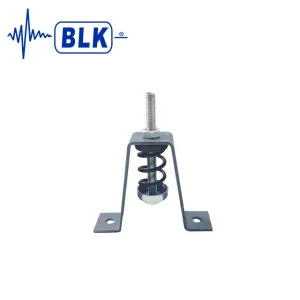
Large chillers, air handling units (AHUs), and inertia-base pump platforms positioned on high-rise mechanical floors generate heavy low-frequency vibration (10 - 30 Hz). Utilizing damped spring mounts (MD/MC type) combined with high-deflection spring hangers (HV type) prevents structure-borne noise transmission into tenant office spaces, ensuring compliance with architectural acoustic standards.
2. High-Voltage Power Transformers & Grid Substations
Power transformers experience continuous electromagnetic hum at 50 Hz/60 Hz and harmonic multiples (100 Hz/120 Hz). Specially engineered transformer anti-vibration mounts isolate core magnetostriction forces, reducing ground-transmitted decibels by 12 dB to 18 dB, while maintaining structural resistance against seismic shear events.
3. Semiconductor Cleanroom Metrology & Lithography
Sub-micron lithography and scanning electron microscopes (SEMs) require isolation from ambient floor vibrations caused by foot traffic and cleanroom ventilation. Precision air mounts (BK-PF/BK-PA series) with pneumatic level-sensing valves maintain height equilibrium within micro-meters while lowering systemic natural frequency to sub-2 Hz levels.
Frequently Asked Questions by Procurement & Engineering Teams
Direct answers regarding selection formulas, customized manufacturing processes, lead times, and factory verification metrics.
Precision Platforms, Damping Pads & Advanced Isolators
Explore specialized polymer pads, precision pneumatic platforms, and heavy-duty spring mounts engineered for maximum dynamic isolation.