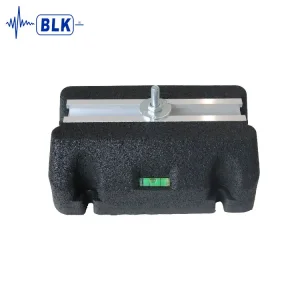
Featured Industrial Vibration Control Systems
Explore our high-performance vibration isolation components manufactured under ISO 9001 certification. Every unit delivers maximum kinetic decoupling, low resonant frequencies, and long-term operating durability.







The Engineering Imperative for Advanced Vibration Isolation Equipment Bases
In modern industrial infrastructure, mechanical vibration is more than an acoustic nuisance; it is a primary driver of mechanical fatigue, operational downtime, energy inefficiency, and structural degradation. As heavy manufacturing, high-precision semiconductor fabrication, and commercial HVAC-R (Heating, Ventilation, Air Conditioning, and Refrigeration) plants scale up operating speeds and power density, the dynamic forces transferred to building structures grow exponentially. Modern facility engineers and procurement managers must strike a delicate balance: securing low price vibration isolation equipment bases direct from manufacturers without sacrificing structural integrity, resonance suppression, or regulatory compliance.
Harmonic Transmissibility & Structural Protection
Unmitigated dynamic forces propagate through concrete slabs, steel girders, and piping systems as structure-borne noise. This causes micro-cracking in floor slabs, premature bearing wear in pumps and chillers, and recalibration failures in sensitive metrology instruments. Engineered inertia bases (such as the CPB series) increase the mass of the equipment assembly, lower its center of gravity, and stabilize rotational torque during startup and transient loading.
Total Cost of Ownership (TCO) Optimization
Procuring OEM-direct vibration isolation equipment bases dramatically reduces capital expenditure while mitigating long-term operational risks. By partnering directly with specialized manufacturing plants in Kunshan, China, industrial buyers unlock factory-direct pricing, custom metallurgical formulations, FEA-validated dynamic load capacity, and complete compliance with ASHRAE and ISO standards.
Physics of Vibration Isolation & Technical Selection Roadmap
Effective vibration mitigation is governed by the relationship between the disturbing frequency of the machine ($f_d$) and the natural frequency of the isolation mount ($f_n$). Isolation occurs only when the frequency ratio ($f_d / f_n$) exceeds $\sqrt{2}$ ($\approx 1.414$). To achieve isolation efficiencies greater than 90%, the frequency ratio should ideally be 3.0 or higher.
| Equipment Category | Typical Disturbing Frequency ($f_d$) | Recommended Isolator Type | Natural Frequency ($f_n$) | Target Isolation Efficiency |
|---|---|---|---|---|
| Low-Speed Chillers & Heavy Pumps | 10 – 25 Hz (600 – 1500 RPM) | Inertia Bases (CPB) + Spring Mounts (MD/MC) | 3.0 – 5.0 Hz | 92% – 98% |
| High-Speed Air Handlers & Compressors | 25 – 60 Hz (1500 – 3600 RPM) | BKDD / BKM Elastomeric Rubber Mounts | 6.0 – 10.0 Hz | 88% – 95% |
| Semiconductor Probing & CMM Metrology | 1.0 – 10 Hz (Micro-seismic hum) | BK-PA Precision Pneumatic Air Mounts | 1.7 – 2.5 Hz | 98% – 99.5% |
| Industrial Power Transformers | 100 – 120 Hz (Electrical hum) | Specialized High-Damping Transformer Mounts | 4.5 – 6.0 Hz | 95% – 99% |
1. Cast Concrete & Steel Inertia Frames
Inertia bases provide a rigid structural foundation filled with concrete. They reduce equipment displacement during transient start-stop cycles, resist high piping side-thrust forces, and ensure uniform load distribution across spring isolators.
2. Viscous-Damped Spring Assemblies
Coil spring mounts engineered from fatigue-resistant spring steel allow large static deflections (25mm to 75mm+). Integrated viscous damping chambers control resonance peaks, preventing violent oscillation during run-up speed transition.
3. Advanced Polymer & Pneumatic Air Springs
For high-frequency acoustic attenuation or ultra-low frequency sub-2Hz applications, specialized oil-resistant neoprene elastomers and auto-leveling pneumatic air mounts eliminate micro-vibrations across all axes.
Procurement Strategies for Low-Cost, High-Spec Vibration Equipment Bases
Global procurement executives face rising cost pressures alongside stringent building safety and noise control regulations. Sourcing direct from established Chinese manufacturing hubs like Kunshan allows EPC (Engineering, Procurement, and Construction) contractors and OEM equipment builders to lower procurement overhead by 30% to 50% compared to Western regional suppliers, without sacrificing product quality.
Why Factory-Direct Sourcing Wins
- Elimination of Intermediary Markups: Purchasing directly from Bellking's 2,000 m² factory guarantees direct manufacturer pricing on standard and custom inertia bases.
- Rapid Engineering Prototyping: Non-standard customized bases designed, engineered, and turned around in as fast as 3 working days.
- High Annual Manufacturing Volume: An annual output exceeding 100,000 units provides robust supply chain reliability for mega-projects.
- Strict Metallurgical Control: Automated robotic welding, CNC machining, and Dacromet coating delivering 900-hour salt spray corrosion resistance.
Cross-Border Compliance Check
When importing vibration isolators and inertia equipment bases globally, engineering teams must verify certification rigor. All Bellking components conform to international production standards:
- ISO 9001:2015 Quality Management System Certification
- 37 National Patents, including 16 Invention Patents
- Compliance with ASHRAE HVAC Vibration Control Standards
- Full Third-Party Factory Inspection & Spectrum Analysis Reports
Macro Industrial Solutions Across Key Demanding Sectors
Commercial HVAC & Building Services
Chillers, cooling towers, and large double-suction pumps installed on upper-floor mechanical rooms generate continuous low-frequency hum. CPB-type inertia bases paired with MD-series spring mounts decouple equipment weight, preventing acoustic bridging into tenant spaces.
Power Distribution & Substation Transformers
Magnetostriction in transformer cores creates continuous 100/120Hz structure-borne noise. High-damping transformer anti-vibration mounts absorb magnetic harmonics, preventing sound propagation into surrounding urban environments and data center floors.
Semiconductor & Cleanroom Precision
Ultra-precise wafer probers, optical benches, and electron microscopes require near-zero ambient vibration. BK-PA pneumatic air mounts deliver sub-2Hz dynamic isolation to safeguard nanometer-level photolithography yields.
Localized Technical Support, Installation Guidance, & Compliance
Procuring hardware is only half the battle; correct sizing and structural installation determine whether a vibration isolation base delivers its theoretical efficiency or fails catastrophically. Bellking provides global engineering support from initial CAD integration through to commissioning.
Our 5-Step Turnkey Customization Protocol
- Requirement & Parameter Review: Dynamic equipment weight, center of gravity position, and operating RPM spectrum evaluation within 24 hours.
- FEA Computer Modeling: Finite Element Analysis to verify frame deflection, stress concentration, and minimum natural frequency.
- Drawing Approval & CAD Integration: Issuance of detailed 3D step files for seamless drop-in integration into master facility designs.
- Precision Production & Surface Finishing: Robotic assembly, Dacromet treatment, and 100% spring rate verification testing.
- Global Fast-Track Shipping: Standard products dispatched within 24 hours; custom bases delivered via direct logistics.
Robust Warranty & After-Sales Commitment
Every vibration isolation equipment base, spring mount, and rubber isolator leaving our Kunshan production facility carries our full manufacturer warranty:
- 1-Year Free Replacment Warranty: Full coverage on mechanical flaws or material defects.
- 15+ Year Expected Service Life: Heavy-duty hot-dip galvanized and Dacromet steel springs engineered for long term duty cycles.
- 24/7 Technical Support Mechanism: Direct communication with senior application engineers for field troubleshooting and seismic tie-down calculations.
Frequently Asked Questions on Vibration Isolation Equipment Bases
Detailed technical answers from our senior vibration control engineers to assist procurement teams and consulting engineers.
Explore Additional Anti-Vibration Base Mounts & Damping Systems
Browse our full range of low-price, high-quality factory-direct isolators engineered for precision machinery, HVAC plants, and structural vibration control.