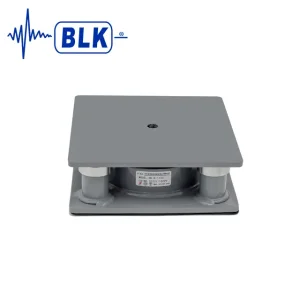
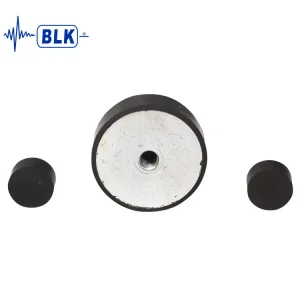
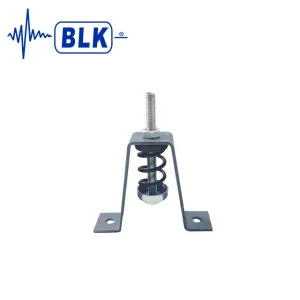
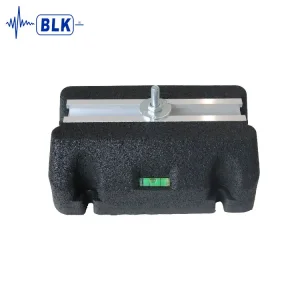
Industrial Grade Vibration Isolator Series
Precision-manufactured anti-vibration mounts, damped spring modules, and high-damping polymer pads designed for rigorous pumping assemblies and industrial equipment.

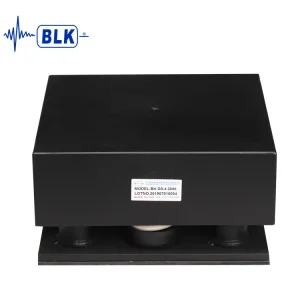
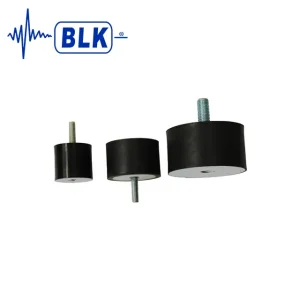
State of Pump Vibration Isolation: Mechanics, Standards & Industry Trends
Exploring structural transmissibility dynamics, modal resonance prevention, and predictive life cycles in high-capacity centrifugal and positive displacement fluid machinery.
Engineering Fundamentals: Dynamic Disturbing Frequencies vs. Natural Resonances
In modern industrial hydraulic systems, fluid transfer infrastructure, and commercial HVAC chilled-water setups, pumps operate as relentless sources of dynamic excitation. A centrifugal water pump operating at standard synchronous speeds (such as 1,450 RPM or 2,900 RPM) creates harmonic forcing frequencies ($f_d$) that align directly with structural framing, causing devastating acoustics, mechanical seal failure, bearing fatigue, and building resonance.
The standard criterion for vibration isolation dictates that mechanical transmissibility across a mounting boundary approaches zero only when the excitation frequency significantly exceeds the system's mounted natural frequency ($f_n$). According to foundational vibrational mechanics: $f_d / f_n \ge \sqrt{2}$ is the absolute mathematical threshold where attenuation begins, but peak attenuation (>90% to 98%) demands a frequency ratio $f_d / f_n \ge 3.0 \text{ to } 4.5$. A factory equipped with advanced static deflection modeling ensures spring geometries deliver natural tuning frequencies down to 3–5 Hz for standard mechanical equipment, and down to 1.7 Hz utilizing precision pneumatic air damping.
Furthermore, without calibrated inertia bases, fluid thrust forces and operational torque generate angular displacement during motor startup and variable frequency drive (VFD) shifts. Incorporating heavily damped inertia blocks decreases overall equipment displacement amplitude and maintains rigid alignment across discharge manifolds.
Dynamic Dynamic Load Shift Control
Variable speed drives introduce broad spectrum excitations. Precision elastomeric dampers and internal viscous snubbers restrain transient amplification during startup and deceleration cycles.
Seismic & Wind Restraint Standards
Manufactured to meet stringent IBC (International Building Code) and ASHRAE requirements, integrating solid ductile housing to prevent dynamic shear failure during high G-force events.
Corrosion Barrier Architecture
Pumping stations regularly endure condensate, chemical spills, and coastal humidity. High-spec Dacromet and electro-deposition coatings assure unyielding endurance passing 900 hours of continuous salt spray testing.
Macro Industry Applications & Targeted Solutions
Engineered damping matrices engineered across petrochemical installations, mission-critical hyperscale data centers, municipal water distribution, and pharmaceutical cleanrooms.
Mission-Critical Data Centers
Cooling loops and chillers running near server halls require strict noise (NC) and micro-vibration compliance. Our spring and inertia mounts prevent hard-drive harmonic disruptions and high-density acoustic transfer.
Commercial High-Rise HVAC
Vertical booster pumps and condenser pumps located on intermediate plant floors transmit low-frequency shuddering into structural concrete. Damped isolators eliminate solid-borne vibration across all occupied levels.
Petrochemical & Slurry Pumping
Heavy pulsating action from positive displacement pumps demands high-durability elastomeric mounts and mechanical snubbing structures engineered to absorb cyclic shocks up to 5G acceleration loads.
Cleanroom & Biotech Facilities
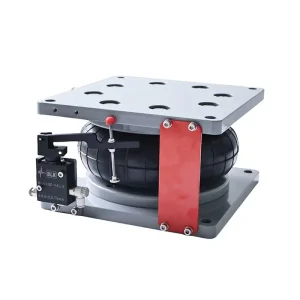
Fluid handling systems adjacent to lithography and precision optical suites utilize pneumatic isolators achieving natural frequencies down to 1.7 Hz, insulating clean rooms from hydraulic pressure wave pulses.
Factory Verification, Quality Assurance & Compliance
Direct OEM/ODM factory capacity, ISO 9001 certified batch tracking, in-house finite element stress simulations, and guaranteed fast cycle customization.
ISO 9001 Certified Quality Control
Strict quality control from raw 60Si2Mn spring steel validation to dynamic fatigue cycles. Every spring assembly undergoes pre-setting and load testing to assure predictable deflection without cold sagging.
24-Hour Dispatch & Rapid OEM Prototyping
Extensive inventory of standard damped spring mounts and polymer pads enables 24-hour order fulfillment. Custom engineered drawings and load distribution schemas delivered in as fast as 3 business days.
Comprehensive Test Documentation
Transparent engineering packages supplied with factory acceptance test (FAT) certs, finite element analysis (FEA) reports, salt spray endurance test data, and vibration transmissibility spectrum validation.
Technology Roadmap: Next-Gen Vibration Reduction
From passive mechanical damping to intelligent IoT-monitored hybrid isolators designed for Industry 4.0 industrial plants.
Phase 1: Advanced Passive Multi-Resin Composites
Integration of nano-engineered elastomers and high-damping polyurethanes delivering structural stability across temperature extremes (-40°C to +120°C) without chemical degradation or elastomeric hardening.
Phase 2: Sensor-Embedded Dynamic Mounts
Development of built-in piezo vibration and temperature sensors inside industrial pump isolators, delivering edge-computed real-time frequency analytics to forecast bearing failure before catastrophic outages.
Phase 3: Active Electromagnetic Hybrid Mounts
Ultra-low frequency active phase-cancellation isolators tuned for large-scale municipal and plant-wide water networks, actively nullifying resonant flutter caused by fluctuating turbine output.
Frequently Asked Technical Questions
Answers to procurement inquiries, load sizing guidelines, and installation best practices from factory application engineers.
How do you choose between spring mounts, rubber isolators, and pneumatic systems for pumps?
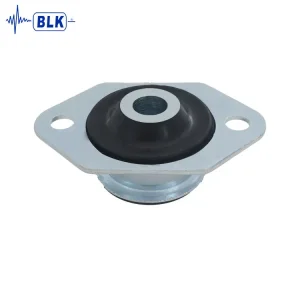
Selection depends directly on the machine's rotating speed (RPM) and the floor's structural stiffness. For low-speed pumps or equipment located on upper building levels, spring isolators with high static deflection (25mm to 50mm) and natural frequencies of 3–5 Hz are necessary to maintain a frequency ratio over 3. For high-speed rotating equipment (>1,800 RPM) located at grade or in solid basements, compact rubber isolators and polymer damping pads are ideal. Precision laboratory fluid systems rely on pneumatic air mounts with 1.7 Hz resonance.
Why is a concrete inertia base required for large centrifugal pumps?
A concrete-filled structural steel inertia base accomplishes three vital engineering functions: it adds mass to lower the center of gravity of the combined motor-pump assembly; it resists dynamic rocking and torsional surge during startup; and it prevents pipe stress by unifying pump volute and piping flanges onto a common, rigid plane.
What environmental treatments are applied to protect mounts from harsh industrial conditions?
All structural metal parts undergo multi-stage surface passivation, including Dacromet plating, electro-galvanization, or heavy powder coating capable of withstanding over 900 hours of continuous ASTM B117 salt spray testing. Elastomeric inserts utilize oil-resistant, ozone-stable polymers formulated to resist hydrocarbon exposure and weather aging.
Can your factory produce non-standard vibration isolators for specialized applications?
Yes. As an authentic manufacturer equipped with laser cutting, robotic welding, and CNC machining, we provide 1:1 tailored isolators based on customer equipment parameters—including custom height constraints, seismic snubbing requirements, off-center weight distributions, and aggressive industrial environments—delivering design blueprints within 24 hours.
What parameters must be provided to obtain an exact engineering sizing calculation?
To compute static deflection and isolator placement, please provide: total operational wet weight (pump + motor + base + fluid), center of gravity location, operating RPM / VFD range, number and positions of support points, and whether seismic or wind load restraints are mandatory.
Specialized Mounts, Cone Isolators & Air Mounts
Explore our specialized matrix anti-vibration systems, cone dampers, precision pneumatic air cushions, and heavy-duty pipe hangers for total mechanical vibration attenuation.