
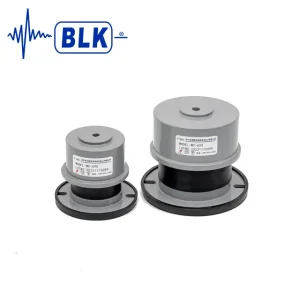
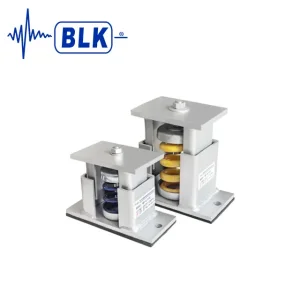
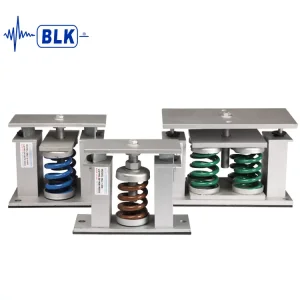
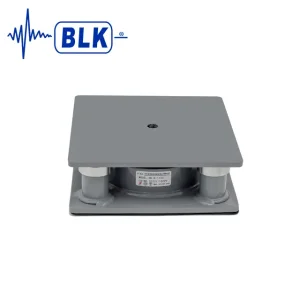
Featured Industrial Anti-Vibration Products (Part I)
Engineered for high-efficiency mechanical isolation across floor, hanging, and wall-mounted setups.

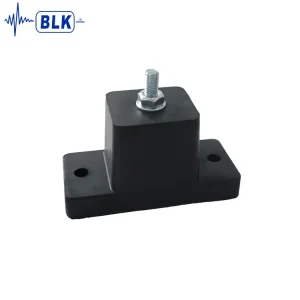
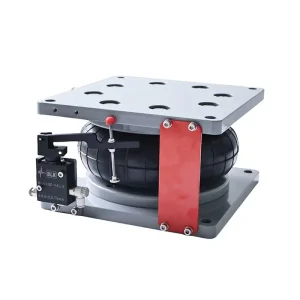
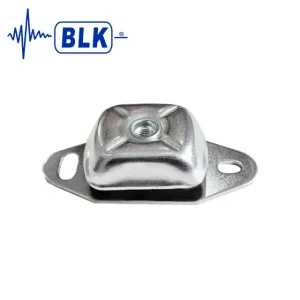
The Paradigm Shift in Wall-Mounted Vibration Isolation Engineering
How modern urban density, modular architecture, and stringent acoustic standards are accelerating demand for advanced wall-mounted isolation technologies.
In modern industrial facilities, high-density commercial complexes, microelectronics fabrication plants, and healthcare infrastructure, spatial constraints have forced a fundamental shift in equipment deployment. Mechanical equipment—ranging from variable-refrigerant-flow (VRF) outdoor units, wall-hung booster pumps, and exhaust air handlers to heavy electrical transformers—is increasingly mounted vertically on load-bearing structural walls rather than traditional floor slabs. This architectural evolution has created complex structural dynamics: wall-mounted equipment transfers both static cantilever shear forces and dynamic rotational vibration moments directly into building envelopes.
According to recent acoustic and structural engineering surveys, structure-borne noise generated by improperly isolated wall-mounted mechanical systems accounts for up to 68% of tenant acoustic complaints in commercial and residential developments. Standard elastomeric grommets or rigid bracket systems fail to isolate low-frequency hums (typically operating between 15 Hz and 60 Hz). Consequently, leading OEMs and engineering procurement teams are turning to specialist factories capable of designing multi-directional, highly damped wall-mounted vibration isolators.
Key Industry Trend: Multi-Axis Damping & Seismic Compliance
Modern wall-mounted isolators must do more than compress vertically; they are engineered with shear-resistant elastomer cores or multi-directional spring matrices to withstand combined axial tensile, shear, and moment loads while satisfying international seismic displacement standards (such as ASCE 7 and IBC guidelines).
Furthermore, the rapid rise of edge computing data centers and cleanroom facilities requires wall-mounted air handling units (AHUs) to maintain continuous operation without transmitting micro-vibration into sensitive optical or server hardware. As a primary manufacturer based in Kunshan, China, Bellking Vibration Reduction Equipment Co., Ltd. has pioneered advanced wall-mounting spring and damped rubber isolators specifically tailored to neutralize these multi-axis dynamic loads.
Shear & Tensile Load Balancing
Specially calculated mechanical housings ensure that high dynamic shear forces generated by wall-hung rotating machinery do not cause shear tear or premature elastic degradation.
Low Natural Frequency Response
Achieving natural frequencies as low as 3 Hz to 5 Hz in spring configurations, eliminating up to 99% of disturbing frequencies from compressors, chillers, and pumps.
Corrosion-Resistant Dacromet Finish
Coating treatments designed to endure 900+ hours of continuous salt spray testing, protecting outdoor wall-hung units in coastal or harsh industrial atmospheres.
Global Corporate Sourcing Demands for Wall-Mounted Isolator Factories
Analysis of procurement criteria, quality assurance benchmarks, and total cost of ownership (TCO) considerations for international EPC contractors and OEMs.
Global procurement teams across North America, Europe, the Middle East, and Southeast Asia face increasingly stringent operational requirements when specifying wall-mounted vibration isolators. Sourcing managers are moving away from commodity suppliers and seeking direct relationships with specialized factories capable of delivering certified performance, customizable load profiles, and predictable supply chains.
Major procurement evaluation criteria currently include:
- Verifiable Dynamic Transmissibility Data: B2B buyers require empirical laboratory test curves demonstrating natural frequency ($f_n$), static deflection ($\delta_s$), and damping ratios ($\zeta$) under varying load states rather than nominal manufacturer estimates.
- Structural Safety Factors: Wall-mounted brackets must possess minimum ultimate tensile and shear strength safety factors of 4:1 or 5:1 to prevent catastrophic mechanical drop hazards under extreme vibration resonance or seismic shock.
- Total Cost of Ownership (TCO): Premium isolators with long-life rubber polymers (RoHS compliant, anti-aging) and high-fatigue alloy steel springs cut maintenance downtime and prevent costly structural retrofits over a 15+ year operational lifespan.
- Rapid Engineering Prototype Delivery: Global projects frequently demand non-standard bolt hole spacing, custom cantilever angles, or hybrid spring-viscous damping configurations within tight project timelines.
| Procurement Metric | Standard Commercial Grade | Bellking Industrial Factory Grade | Operational Impact |
|---|---|---|---|
| Isolator Natural Frequency ($f_n$) | 8 Hz – 15 Hz (High residual hum) | 1.7 Hz – 5.0 Hz (Ultra-low frequency) | Eliminates up to 99% of structure-borne noise in wall assemblies. |
| Salt Spray Corrosion Resistance | 48 – 120 Hours (Basic spray paint) | 900+ Hours (Dacromet / Galvanized) | Prevents rusting and shear structural failure in harsh coastal environments. |
| Customization Turnaround | 4 – 8 Weeks (Outsourced trading) | 3 Working Days (In-house OEM/ODM R&D) | Keeps fast-track EPC construction projects strictly on schedule. |
| Expected Service Life | 2 – 5 Years (Elastomer hardening) | 15+ Years (Spring) / 6+ Years (Air) | Significantly lowers long-term plant maintenance expenditure. |
China Industry 4.0: Bellking's Supply Chain Resilience & Manufacturing Superiority
Operating a state-of-the-art 2,000 m² production complex in Kunshan, China—integrating robotic automation, raw material traceability, and rigorous quality control.
As global supply chains face increasing volatility, international buyers require manufacturing partners with robust supply chain resilience, complete process ownership, and rapid scalability. Bellking Vibration Reduction Equipment Manufacturing (Kunshan) Co., Ltd., established in 2013, exemplifies China's Industry 4.0 manufacturing transformation.
Located in the heart of Yangtze River Delta's high-tech industrial cluster in Kunshan, Jiangsu, Bellking leverages an integrated regional supply chain network for raw spring alloys, natural rubber formulations, precision CNC machining, and automated surface treatment. This ecosystem enables 100% material traceability and uninterrupted manufacturing schedules even during global logistics bottlenecks.
Robotic Fabrication & Precision CNC
Automated robotic welding and high-precision CNC machining ensure identical wall bracket mounting dimensions, zero internal stress flaws, and structural rigidity tested to withstand 3G–5G shock acceleration.
In-House Testing & ISO 9001 Auditing
Every wall-mounted batch undergoes rigorous quality assurance via in-house tension-compression dynamic testers, digital spectrum analyzers, and salt spray testing chambers before factory exit.
Selection Guide & Mechanical Calculations for Wall-Mounted Vibration Isolators
A technical step-by-step sizing methodology for HVAC, structural, and acoustic design engineers.
Selecting the correct wall-mounted isolator requires a rigorous evaluation of the system's operating parameters. Unlike floor mounts where load is purely compressive, wall-mounted applications involve a combination of vertical shear ($F_v$), overturning cantilever moment ($M_c$), and dynamic horizontal thrust forces ($F_h$).
1. The Frequency Ratio Criterion
Vibration isolation occurs only when the ratio of the equipment's disturbing frequency ($f_d$) to the isolator's natural frequency ($f_n$) exceeds $\sqrt{2} \approx 1.41$. For high-performance industrial isolation (>90% efficiency), engineers target a frequency ratio of:
Where equipment disturbing frequency ($f_d$) in Hz is derived from operating RPM:
$f_d = \frac{\text{RPM}}{60}$
For example, a wall-mounted pump running at 1,750 RPM generates a disturbing frequency of $f_d = 29.17\text{ Hz}$. Paired with a Bellking wall-mounted spring isolator with a natural frequency of $f_n = 4.2\text{ Hz}$, the resulting ratio is $\frac{29.17}{4.2} = 6.94$, yielding an isolation efficiency exceeding 97.8%.
2. Wall Cantilever Load & Center of Gravity Calculation
When an equipment unit of mass $M$ (kg) extends outward from a wall by distance $L$ (distance from wall surface to equipment Center of Gravity), the upper wall bracket experiences a combined tensile pull-out force ($T_u$), while the lower bracket experiences compression ($C_l$). Engineers must calculate:
$T_u = \frac{M \cdot g \cdot L}{H} + \text{Dynamic Thrust Component}$
Where $H$ is the vertical distance between top and bottom mounting isolator bracket holes, and $g = 9.81\text{ m/s}^2$. Bellking's engineering team provides free computational load calculations for global procurement clients within 24 hours to ensure 100% bracket safety margin compliance.
Localized Application Scenarios & Engineering Case Studies
How Bellking wall-mounted and industrial isolators solve complex acoustic and mechanical problems in real-world environments.
High-Rise Luxury Hotel HVAC Wall Isolation
Challenge: Wall-mounted chiller pumps mounted directly onto structural partition walls were transmitting 42 dBA low-frequency hums into adjacent guest suites.
Solution: Custom Bellking wall-bracket spring mounts with neoprene shear pads were installed, reducing acoustic noise levels to below NC-25 standard (24 dBA).
Substation Electrical Transformer Mounts
Challenge: Core magnetostriction humming from 15kV dry-type transformers located in urban commercial basements created building-wide hum.
Solution: High-damping Bellking transformer anti-vibration mounts isolated 98.4% of 100 Hz/120 Hz fundamental magnetostriction hum.
Semiconductor Cleanroom Metrology Isolation
Challenge: Ambient facility micro-vibrations interfered with optical wafer probing equipment precision.
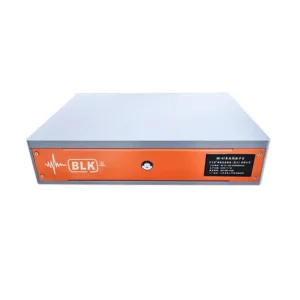
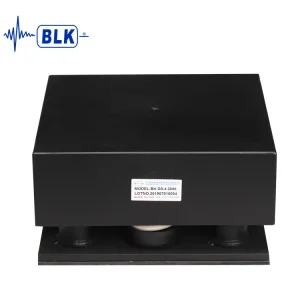
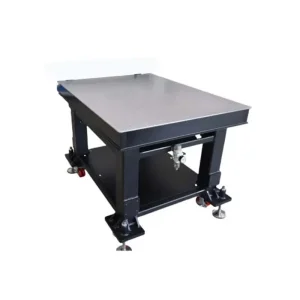
Solution: Bellking BK-PF precision pneumatic air mounts stabilized measuring tables with low natural frequencies down to 1.7 Hz.
Featured Industrial Anti-Vibration Products (Part II)
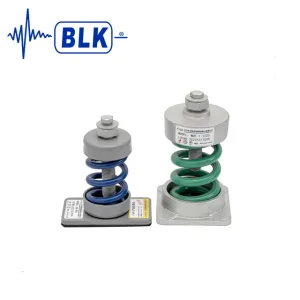
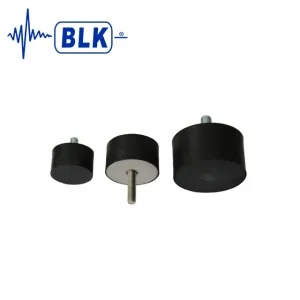
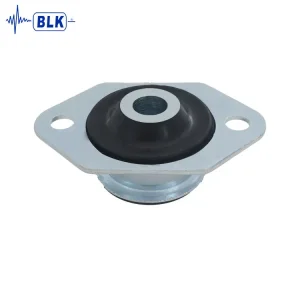
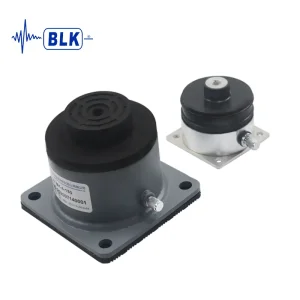
Explore specialized spring, damped rubber, pneumatic, and precision platform isolators for global procurement.

Frequently Asked Engineering & Sourcing Questions
In-depth answers from Bellking application engineers regarding wall-mounted and industrial isolator sizing, installation, and procurement.
How do wall-mounted vibration isolators differ mechanically from standard floor-mounted isolators?
How do I select between spring, rubber, and pneumatic vibration isolators?
What specific technical data is needed to request a custom wall-mounted isolation design?
What corrosion protection coatings are applied for outdoor wall installations?
What lead times and quality certifications does Bellking provide for overseas buyers?
Request a Custom Engineering Solution & Factory Catalog
Partner directly with Kunshan Bellking—37 patents, ISO 9001 certified quality control, and 24-hour engineering response for global B2B procurement teams.