
Core Generator & Heavy Machinery Mount Series
Explore our industrial-grade anti-vibration mounts engineered for superior low-frequency isolation, high static load capacity, and long-term dynamic stability.


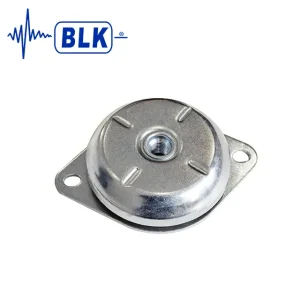





Executive Technical Brief: Next-Generation Generator Vibration Control
An in-depth analysis of structural dynamics, acoustic attenuation economics, and OEM sourcing strategies for power generation infrastructure.
Macro Industry Evolution
The global power generation market is undergoing a structural shift toward distributed energy, high-density data centers, microgrids, and localized emergency standby power. As internal combustion diesel and gas engines scale up in power density, unmitigated vibration harmonics present severe risks to structural integrity, nearby optical or electronic instrumentation, and environmental noise compliance (ISO 8528-9 / ISO 10816). High-performance generator vibration mounts are no longer passive rubber blocks; they are engineered dynamic isolators designed to handle combined axial, shear, and rotational forces under severe thermal and environmental stress.
Economic Imperative of Low-Cost Sourcing
For OEM generator set manufacturers and EPC contractors, balance-of-plant procurement costs directly dictate market competitiveness. Achieving "Low Price" without compromising mechanical safety or vibration isolation performance requires direct-from-factory manufacturing engineering. By vertically integrating raw polymer compounding, automated spring coiling, robotic welding, and Dacromet surface anti-corrosion treatments, leading Chinese factories eliminate multi-tiered distributor margins, providing enterprise buyers with up to 40% cost reduction per unit while meeting or exceeding Western standards (ASHRAE, CE, ISO 9001).
Core Engineering Takeaway: Vibration transmissibility ($T$) drops dramatically when the ratio of disturbing frequency ($f_d$) to isolator natural frequency ($f_n$) exceeds 3. Sourcing precision-engineered mounts with low natural frequencies ($3-5\text{ Hz}$ for springs, down to $1.7\text{ Hz}$ for pneumatic systems) guarantees high attenuation efficiency (>95%), preventing structure-borne noise from propagating through floor slabs into critical facilities.
Vibration Isolation Physics & Material Selection Matrix
Understanding the mathematical framework behind dynamic response, damping ratios, and stiffness selection for industrial rotating equipment.
| Isolator Architecture | Natural Frequency ($f_n$) | Damping Ratio ($\zeta$) | Primary Industrial Application | Environmental Durability |
|---|---|---|---|---|
| Spring Mounts with Viscous Damping | 3.0 – 5.0 Hz | 0.05 – 0.15 | Low RPM Gensets (720–1800 RPM), HVAC Chillers, Large Compressors | High (Dacromet / Galvanized Steel, -40°C to 120°C) |
| High-Damping Elastomer Mounts | 7.0 – 12.0 Hz | 0.15 – 0.25 | High-Speed Engines (1800+ RPM), Mobile Power Gensets, Marine Auxiliaries | Excellent Oil & Chemical Resistance (NBR / EPDM / Neoprene) |
| Matrix Anti-Vibration Pads | 8.0 – 15.0 Hz | 0.10 – 0.20 | Transformer Base Sub-assemblies, Heavy Stamping, Floor Shear Isolation | Extreme Wear & Chemical Immunity |
| Pneumatic Air Mounts | 1.7 – 3.0 Hz | 0.03 – 0.08 | Ultra-sensitive Optical Platforms, Metrology, Micro-vibration Gensets | Controlled Indoor / Cleanroom Environments |
Disturbing Frequency vs. Natural Frequency
For a generator operating at $1500\text{ RPM}$ (50 Hz power output), the primary disturbing frequency is $f_d = 25\text{ Hz}$. If a standard rubber mount with a natural frequency of $12\text{ Hz}$ is installed, the frequency ratio $f_d / f_n \approx 2.08$, yielding an isolation efficiency of roughly 75%. However, substituting a damped spring isolator with $f_n = 4\text{ Hz}$ pushes the frequency ratio to $6.25$, increasing isolation efficiency to over 97%. This distinction is critical for data centers and healthcare institutions where low-frequency rumble causes acoustic resonance in building facades.
Transient Resonance & Dynamic Damping
During generator start-up and shutdown sequence, engine speed passes through the resonance point ($f_d = f_n$). Without adequate viscous or elastomer damping, unamplified resonance causes violent engine movement, stress-cracking fuel lines, exhaust flexible joints, and electrical conduits. Bellking’s hybrid damped mounts (BK-DS and BK-DSR series) incorporate high-viscosity silicone or engineered rubber buffers to limit transient amplitude spikes to under $2.5\text{ mm}$, protecting peripheral piping while maintaining maximum high-frequency attenuation during steady-state operation.
Global Sourcing & Factory Direct OEM Value Proposition
How global procurement leads optimize Total Cost of Ownership (TCO) through direct manufacturer partnerships in China's industrial manufacturing hubs.
Eliminating Middleman Markup
Traditional procurement through Western regional distributors often incurs $200\% - 400\%$ markups due to stockholding overhead, multi-tiered agent margins, and regional brand licensing fees. By partnering directly with specialized ISO-certified manufacturers in Kunshan, China, enterprise buyers access factory-gate pricing. Standard spring and rubber mounts are manufactured under lean production schedules, allowing volume buyers to secure low prices while maintaining full design specification compliance.
100% Quality Verification & Test Standards
Cost reduction must never come at the expense of structural reliability. Bellking implements zero-defect quality control protocols: 60Si2Mn high-grade spring steel undergoes shot peening and static load deflection testing; rubber formulations are evaluated via micro-durometer and tensile modulus analysis; finished metal housings receive 900-hour neutral salt spray exposure tests to ensure zero rust formation in marine or high-humidity tropical installations.
Agile Customization & Rapid Tooling
Non-standard generator baseframes frequently require modified mounting bolt hole patterns, non-standard height adjustments, or specialized load-bearing plates. Bellking’s in-house tooling center produces customized mechanical drawings within 24 hours and physical prototypes within 3 to 5 business days. This speed significantly accelerates generator OEM product launch cycles and simplifies retrofit engineering for complex field projects.
Targeted Solutions Across Diverse Power Generation Environments
Customized vibration isolation strategies designed for critical infrastructure, harsh environments, and strict municipal acoustics.
1. Data Center & Healthcare Backup Power
Hyperscale facilities require instant standby power generation (1000kVA – 3250kVA gensets). Due to high roof loads or raised access floors, unmitigated vibration can cause micro-cracks in concrete slabs or interfere with server hard drives. Our solution pairs heavy-duty BK-DS damped spring isolators with reinforced concrete inertia bases, lowering the system's center of gravity and absorbing over $98\%$ of dynamic force transmission.
2. Marine Auxiliaries & Offshore Power Vessels
Generator mounts on ships and oil rigs must absorb violent multi-axis wave motion, hull flexing, and constant engine vibration. Elastomer shear-compression mounts (BKH and BKP series) feature fail-safe interlocking steel housings that capture the internal rubber element. In the event of extreme wave impact or rollover, the mount prevents engine displacement, meeting Lloyd's Register and DNV marine safety standards.
3. Rooftop & Commercial Building HVAC / Power
Installing standby generators on upper levels of commercial towers presents severe acoustic challenge. Structure-borne sound travels efficiently through steel-reinforced concrete columns, generating low-frequency hum in tenant spaces below. Combining ceiling isolation hangers for exhaust piping with high-deflection spring mounts under the engine skid cuts structure-borne noise levels by up to $25\text{ dBA}$.
4. Mobile Containerized & Rental Power Units
Rental gensets mounted inside ISO shipping containers face severe road shocks during highway transportation and off-road deployment. Mounts installed in these units must offer dual functionality: low stiffness at operating RPM for vibration isolation, and high transient shock absorption to withstand up to $3-5\text{G}$ dynamic impact without plastic deformation.
Global Regulatory Compliance & Localized Technical Support
Ensuring full alignment with international engineering codes, environmental directives, and rapid site-level technical guidance.
ISO 8528-9 & ISO 10816 Standards Alignment
ISO 8528-9 defines limits for mechanical vibration on reciprocating internal combustion engine driven alternating current generating sets. Bellking isolators are factory calibrated to keep broad-band vibration velocity RMS levels well within 'Zone A' (good condition per ISO 10816-3), protecting engine crankshafts, alternator bearings, and control cabinets from fatigue failures.
Environmental & Chemical Safety Compliance
All elastomeric elements (Natural Rubber, Neoprene, NBR, Silicone) are fully compliant with EU REACH and RoHS regulations, eliminating toxic heavy metals, phthalates, and Polycyclic Aromatic Hydrocarbons (PAHs). Products designed for cleanrooms or food processing backup gensets utilize non-outgassing silicone and stainless steel components.
Engineering Sizing Assistance & On-Site Audits
Selecting the correct mount requires accurate calculation of total operating mass, center of gravity location, engine RPM, torque reaction forces, and point load distribution. Bellking provides global EPCs with complimentary engineering analysis: send us your equipment CAD model or weight distribution sheet, and our engineering team returns a full vibration calculation report within 24 hours.
Technology Roadmap: The Future of Industrial Vibration Control (2026–2035)
Pioneering active damping systems, IoT condition monitoring, and sustainable elastomeric chemistry for next-generation power infrastructure.
1. Smart Mounts with Embedded Wireless IoT Sensors
The convergence of predictive maintenance and vibration isolation is ushering in smart mounts. Future Bellking isolators integrate piezoelectric sensors and wireless LoRaWAN / Bluetooth micro-transmitters directly into the top plate. This allows plant managers to monitor real-time vibration amplitude, temperature, and static deflection trends via cloud dashboards, detecting alignment faults or bearing wear months before catastrophic failure occurs.
2. Active Electro-Hydraulic & Magnetorheological Isolation
While passive spring and rubber mounts excel at steady-state RPM isolation, emerging hybrid microgrid gensets experience rapid load changes and variable operating speeds. Bellking’s R&D laboratory is testing active magnetorheological (MR) fluid dampers that automatically adjust stiffness and damping coefficients within milliseconds, providing real-time adaptability across fluctuating engine speed profiles.
3. Bio-Based & Recyclable Elastomeric Polymers
To align with global net-zero carbon goals, Bellking is developing eco-friendly synthetic rubbers derived from plant-based feedstocks and recycled fluoroelastomers. These sustainable formulations offer equivalent mechanical loss factors, ozone resistance, and thermal endurance as traditional petroleum-derived compounds, reducing the embodied carbon footprint of industrial vibration hardware.
Precision Platforms, Air Mounts & Specialty Isolation Pads
Specialized solutions for ultra-low frequency isolation, optical platforms, transformer noise reduction, and structural buffers.




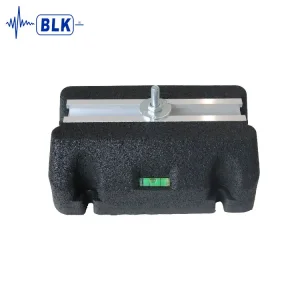

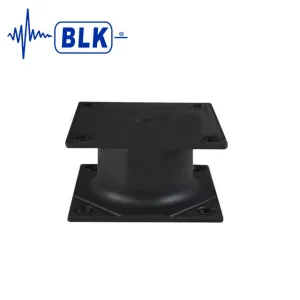
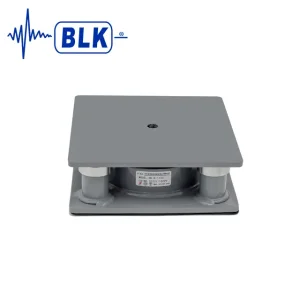
Frequently Asked Questions: Industrial Generator Vibration Isolation
Comprehensive engineering responses regarding selection methodology, installation practice, and total cost optimization.