
Low Price Pneumatic Vibration Isolators Manufacturer & Price in Austria
Precision-engineered air mounts and active-ready passive isolation systems designed for Austrian microelectronics, high-precision machining, and laboratory metrology. Direct factory cost efficiency compliant with DIN EN ISO standards.
Precision Air Mount Isolators for Austrian Cleanrooms & Laboratories
Ultra-low natural frequency attenuation systems engineered to protect Austrian metrology suites, semiconductor photolithography stations, and optical test benches from low-frequency structural excitation.

Austria Precision BK-A Type Low Frequency Air Mounts
- Natural Frequency: 1.5 - 2.5 Hz
- Auto-Leveling Precision: ±0.05 mm
- Load Capacity: Up to 1,200 kg/point
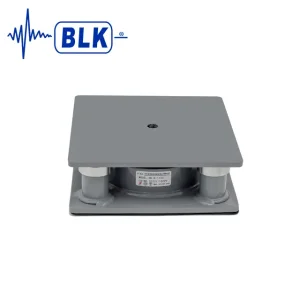
Austria Industrial BK-R Type Heavy-Duty Air Mounts
- Natural Frequency: 2.0 - 3.2 Hz
- Integrated Damping Chamber
- Dacromet Anti-Corrosion Finish

Austria Laboratory BK-PA Type Precision Air Mounts
- Natural Frequency: Down to 1.2 Hz
- 3-Way Mechanical Sensor Leveling
- Ideal for CMM & Electron Optics

Austria Flange-Type BK-PF Precision Air Isolators
- Natural Frequency: 1.7 - 2.8 Hz
- Bolt-Down Flange Architecture
- Zero Static Friction Seal Design
Industrial Dynamics: Why Austrian High-Tech Manufacturing Demands Ultra-Low Frequency Vibration Control
Austria stands as an advanced industrial powerhouse in Central Europe, anchoring global leadership across power semiconductor fabrication in Carinthia (Villach), mechatronics and precision engineering in Upper Austria (Linz, Wels, Steyr), high-end automotive powertrain testing in Styria (Graz), and biotechnology in the Vienna metropolitan area. As microchip transistor architectures drop below sub-3nm geometries and automated manufacturing operations shift toward micron-tolerance coordinate measuring machines (CMM) and laser interferometry, environmental and floor-borne vibrations have emerged as critical structural liabilities.
In facilities operating adjacent to heavy transport corridors, rail freight (ÖBB), or heavy factory machinery (such as mechanical presses and high-speed CNC milling systems), structural vibration within the 1.0 Hz to 20 Hz spectrum easily penetrates building foundations. Steel coil springs, which possess high internal resonance and typical natural frequencies between 3.5 Hz and 6.0 Hz, frequently fail to eliminate structural excitation in these sensitive ranges, risking resonance amplification. Pneumatic vibration isolators (air mounts) overcome these fundamental physical limitations by leveraging pressurized elastomeric chambers with an adjustable air column, shifting the system natural frequency down to 1.2 Hz – 2.0 Hz and providing greater than 95% attenuation across critical disturbance frequencies.
Silicon Alps Microelectronics (Villach & Graz)
Micro-lithography, wafer probing, and packaging require rigid vibration-free environments compliant with VC-D, VC-E, and NIST-A criterion curves to eliminate optical pattern distortion.
Upper Austria Precision Machine Tooling
Automated coordinate measurement machines and diamond turning lathes require mechanical self-leveling to counteract dynamic payload shifts during high-speed axis acceleration.
Austrian Workplace Safety & DIN Compliance
Strict observance of the Austrian Lärm- und Vibrations-Verordnung (VOLV) and DIN ISO 10816 ensures human vibration mitigation and long-term acoustic structural integrity.
The Physics of Pneumatic Isolation: Eliminating Structural Resonance
Vibration isolation efficiency is governed by the frequency ratio $r = f_d / f_n$, where $f_d$ is the forcing or disturbing frequency emitted by factory machinery or ambient ground traffic, and $f_n$ is the undamped natural frequency of the vibration mount. Isolation commences only when the frequency ratio satisfies $r > \sqrt{2} \approx 1.414$. At lower ratios, particularly when $r \approx 1.0$, system resonance occurs, drastically magnifying vibration amplitudes and threatening equipment alignment.
Standard rubber mounts generally possess an $f_n$ between 7 Hz and 15 Hz, rendering them ineffective against low-frequency ground hum (5–12 Hz). High-deflection steel springs achieve $f_n \approx 3.0\text{--}4.5\text{ Hz}$, but suffer from high-frequency acoustic bypass (surging) along the metal spring coil. Pneumatic isolators break this limitation by employing a variable-pressure gas spring (air spring) combined with an internal flow orifice or laminar damping chamber. The natural frequency can be tuned down to $1.2\text{--}1.7\text{ Hz}$, enabling 90% isolation efficiency at 5 Hz and up to 99% attenuation above 15 Hz.
| Isolator Technology Type | Natural Frequency ($f_n$) | Isolation Efficiency @ 10 Hz | Auto-Leveling Precision | High-Frequency Surge Bypass | Austrian Pricing Benchmark |
|---|---|---|---|---|---|
| Pneumatic Air Mounts (Bellking BK-PA/PF) | 1.2 Hz – 2.0 Hz | > 96.5% | ±0.05 mm (Mechanical Valve) | Zero (Elastomeric Gas Barrier) | Direct Factory: €320 – €850 |
| Viscous Damped Coil Springs | 3.2 Hz – 5.0 Hz | 75% – 85% | Manual Shimming Required | Moderate (Solid Coil Transmission) | EU Regional: €580 – €1,400 |
| High-Density Nitrile Rubber / Neoprene | 8.0 Hz – 18.0 Hz | < 20% (Resonance Risk) | None (Static Deflection Dependent) | Low | EU Regional: €85 – €220 |
| Active Piezoelectric / Electrodynamic Systems | 0.5 Hz – 1.0 Hz | > 98.0% | Dynamic Sub-Micron Feedback | Zero (Electronic Counter-Force) | European OEM: €12,000 – €35,000 |
*Data compiled based on ISO 10816 standards, empirical transmissibility measurements, and Central European procurement averages.
Factory-Direct Engineering: The China Supply Chain Advantage for Austrian Enterprises
Austrian procurement directors and plant engineers frequently face massive markup multiples (typically 200% to 400%) when sourcing precision air mounts through intermediary European trading agencies or domestic German/Swiss catalog distributors. These trading entities frequently re-brand Asian precision components or pass on significant regional stock-holding overhead to end users, resulting in unit costs ranging from €1,200 to upwards of €3,500 per point for high-precision pneumatic mounts.
Bellking eliminates intermediate markups by supplying Austrian high-tech industries direct from our integrated 2,000 m² intelligent manufacturing facility in Kunshan, China. Kunshan's specialized industrial robotics and advanced elastomer clustering enable rapid raw material processing, automated robotic CNC machining, and specialized vulcanization of airtight membranes under strict ISO 9001:2015 quality regimes. As a result, Austrian facilities secure high-performance air mounts delivering equivalent or superior isolation parameters at 40% to 60% lower total procurement cost.
Furthermore, customized Austrian engineering requirements (such as specialized DIN flange drill patterns, low-outgassing cleanroom fluoropolymer bladders, or metric manifold interfaces) are designed, FEA-simulated, and manufactured within 3 to 5 business days. Rapid air-cargo logistics to Vienna Airport (VIE) or freight consolidation via Port of Koper / Port of Hamburg ensures rapid delivery windows for plant retrofit or urgent line installations.
Compliance & Legal Framework in Austria: CE, DIN EN ISO & VOLV
Deploying machinery vibration control in the Republic of Austria requires strict adherence to both European Union Harmonized Directives and domestic Austrian industrial statutory regulations. Industrial components must seamlessly integrate into technical construction files under the EU Machinery Directive 2006/42/EC (transitioning to Machinery Regulation EU 2023/1230), guaranteeing mechanical failsafe containment under sudden air loss or dynamic seismic events.
Bellking pneumatic isolators and rubber mounting solutions fulfill all relevant Central European engineering standards:
ASchG & VOLV Compliance
Conforms to Austria's ArbeitnehmerInnenschutzgesetz and Verordnung Lärm und Vibrationen, ensuring mechanical emissions remain far below statutory daily worker exposure action values.
DIN ISO 10816 Verification
Evaluated against mechanical vibration criteria across industrial machinery classes, ensuring bearing longevity, low foundation wear, and minimal structure-borne acoustic radiation.
ISO 14644-1 Cleanroom Readiness
Fabricated using non-blooming elastomers, high-purity brass air valves, and electropolished or Dacromet-shielded housings that release no particulate matter in cleanroom classifications.
Engineer's Sizing Protocol: Step-by-Step Pneumatic Isolation Calculation
To accurately select a pneumatic mount configuration for machinery operating in Austrian research centers or manufacturing plants, mechanical project engineers must evaluate four interconnected physical variables: total operating weight, dynamic center of gravity (CoG), lowest disturbing frequency ($f_d$), and ambient environmental vibration criteria (VC curve standards).
| Calculation Step | Governing Formula | Engineering Significance for Facility Design |
|---|---|---|
| 1. Natural Frequency ($f_n$) | $f_n = \frac{1}{2\pi} \sqrt{\frac{k_{dyn}}{m}}$ | Determines where resonance peak occurs. For air mounts, gas column compressibility allows $f_n$ to remain independent of static payload mass changes. |
| 2. Frequency Ratio ($r$) | $r = \frac{f_d}{f_n}$ | Target ratio must satisfy $r \ge 3.0$. Example: For a precision high-speed spindle operating at 3,000 RPM (50 Hz), pairing with a 2.0 Hz air mount yields $r = 25$, ensuring near 99% isolation. |
| 3. Transmissibility ($T$) | $T = \sqrt{\frac{1 + (2\zeta r)^2}{(1 - r^2)^2 + (2\zeta r)^2}}$ | Quantifies residual vibration transmitted to base structure. Lower transmissibility ensures structural quietness in sensitive lab floors and adjacent cleanrooms. |
| 4. Operating Air Pressure | $P = \frac{W_i}{A_{eff}} + P_{atm}$ | Calculates necessary supply gauge pressure (typically 0.3 – 0.6 MPa) from plant pneumatic lines to float individual support points at nominal design height. |
Need Custom Calculation Assistance? Bellking provides comprehensive 24-hour engineering reports, providing full center-of-gravity load balancing calculations and vibration transmissibility curves tailored to your plant schematics.
Full Industrial Vibration Mount & Elastomer Series for Austria
From micro-vibration pneumatic units to heavy industrial spring mounts and elastomeric damping pads, explore our complete product inventory manufactured in Kunshan and delivered across all Austrian federal states.
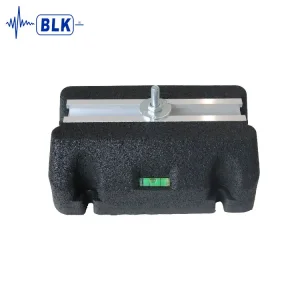
Austria High-Elastic BKDJ Type Rubber Vibration Pad
- Non-slip waffle grid profile
- Resistant to industrial oils & greases
- Standard 300x300mm & custom cuts

Austria Industrial BKDE Type Compact Rubber Mounts
- High lateral stability architecture
- Natural frequency: 7 - 12 Hz
- Metric threaded central stud

Austria Enclosed BK-DS Type Damped Spring Mounts
- Natural frequency: 3.0 - 4.5 Hz
- Internal viscous fluid damping
- Dacromet 900h salt spray rating
Austria Heavy BK-A Series Multi-Point Air Mounts
- Dynamic leveling manifold link
- Isolation efficiency up to 99%
- Service lifespan > 6-8 years
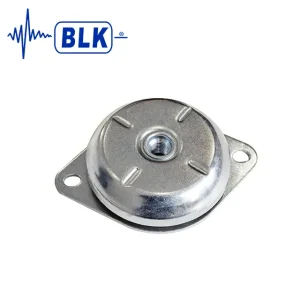
Austria High-Load BKH Type Shear Rubber Mounts
- Integrated anti-tear limiters
- Engineered shear & compression axis
- Heavy industrial gear pumps

Austria Male-Thread BKVV Cylindrical Rubber Isolators
- Dual male galvanized studs (DIN 933)
- High-grade NR/NBR elastomer
- High cost-efficiency mass production

Austria Female-Thread BKM Type Rubber Mounts
- Flush internal blind threaded bore
- Prevents high-frequency structural noise
- Compact profile for tight sub-bases
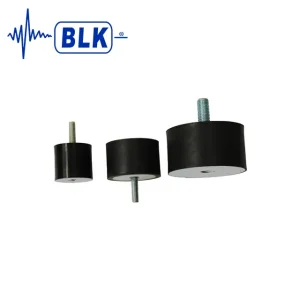
Austria Dual-Stud BKVD Heavy Industrial Buffers
- 3 to 5 G impact deceleration capability
- Vulcanized steel bonding interface
- Designed for heavy automation skids
Frequently Asked Questions by Austrian Engineers & Purchasers
Expert answers addressing customs duties, DIN standards, leveling accuracy, and lead times for Austrian deliveries.
What are the key price determinants for pneumatic vibration isolators delivered to Austria?
How does Bellking guarantee customs clearance and compliance under Austrian import law?
Can your pneumatic isolators handle sudden dynamic weight shifts on CNC machines or CMMs?
What are the lead times for custom mounting configurations for Austrian production lines?
What maintenance and service life can Austrian facilities expect in continuous 24/7 operation?
Optimize Your Machine Stability with Direct Factory Air Isolators
Submit your machine specifications, total mass, and disturbing frequency today. Our application engineering team will return a customized 24-hour vibration attenuation plan, CAD step models, and competitive direct-factory price quote for your Austrian operations.
Send Inquiry Now